
Cyber Assessment Framework: Who Is It For and Do We Need It?
Are you responsible for protecting your organisation’s critical systems but unsure where to start? With cyber attacks costing UK businesses thousands per breach, having a robust cybersecurity framework isn’t optional anymore. The Cyber Assessment Framework (CAF) offers a clear roadmap for organisations to assess and strengthen their cyber defences.
What Is the Cyber Assessment Framework?
The Cyber Assessment Framework is the UK government’s official guidance for assessing cybersecurity risks in essential services. Developed by the National Cyber Security Centre (NCSC), the CAF provides a systematic approach to evaluating how well organisations protect themselves against cyber threats.
The framework primarily applies to operators of essential services under the Network and Information Systems (NIS) Regulations, including energy, transport, health, water supply, digital infrastructure, and financial services. However, any UK organisation handling sensitive data can benefit from CAF implementation.
The Four Core Objectives and 14 Principles
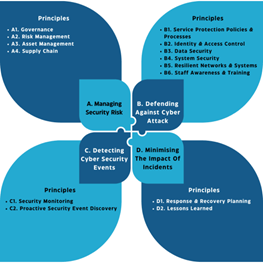
The CAF framework centres on four fundamental objectives: managing security risk, protecting against cyber attack, detecting cybersecurity events, and minimising impact. Within these sit 14 detailed principles covering everything from governance and risk management to incident response and recovery.
Managing Security Risk (Principles A1-A4) involves understanding your risk appetite, maintaining asset inventories, securing your supply chain, and establishing clear governance structures.
Protecting Against Cyber Attack (Principles B1-B5) focuses on secure service design, vulnerability management, identity controls, data security, and proper system configurations.
Detecting Cybersecurity Events (Principles C1-C2) requires continuous monitoring and comprehensive logging to spot threats quickly.
Minimising Impact (Principles D1-D3) ensures resilience through response planning, lessons learned processes, and recovery capabilities.
Practical Implementation Steps
Start by conducting a gap analysis against each principle. Document existing controls and identify weaknesses honestly. Not every gap requires immediate attention, so prioritise improvements based on risk to your most critical assets.
Create an implementation roadmap with realistic timelines. Breaking work into manageable phases prevents overwhelm and ensures steady progress. Engage stakeholders across your organisation because cybersecurity isn’t just an IT problem.
Many organisations struggle with limited budgets and skills shortages. Calculate potential breach costs versus prevention spending to build your business case. Consider partnering with managed security service providers or investing in staff training. The NCSC offers free guidance resources to supplement commercial training.
Document evidence for each principle demonstrating how you achieve required outcomes. This proves compliance during audits and tracks improvement over time. Consider engaging independent assessors for objective evaluations.
Benefits Beyond Compliance
Implementing the CAF delivers advantages extending well beyond regulatory compliance. Enhanced security reduces incident frequency and severity, lowering overall costs. Customer trust increases when you demonstrate robust cybersecurity practices, becoming a competitive differentiator.
Insurance premiums often decrease for organisations with mature cybersecurity frameworks. Operational efficiency improves through better asset management and streamlined processes discovered during CAF implementation.
Staying Current with Evolving Threats
Cyber threats constantly evolve, and your defences must keep up. The NCSC regularly updates CAF guidance to reflect emerging risks. Subscribe to NCSC alerts and threat intelligence feeds relevant to your sector.
Conduct regular penetration testing to reveal whether defences work as intended. Review and update your CAF assessment annually at minimum, with interim reviews triggered by significant IT changes or emerging threats.
Cyber Assessment Framework – NCSC.GOV.UK
Your Next Steps
The Cyber Assessment Framework provides proven structure for building cyber resilience in UK organisations and SMBs. Begin today by downloading official CAF guidance from the NCSC website. Perfect security doesn’t exist. The goal is continuous improvement and proportionate risk management. Every step towards CAF implementation strengthens your defences and protects critical services millions depend upon.
Need help understanding the CAF framework in a bit more detail? Get in touch! At Three Cherries, we take the gamble out of business technology.
CALL THE IT EXPERTS
SPEAK TO US TODAY
Contact our friendly and knowledgeable team today for IT support Bristol and the South West.
